
Identification guide
Bee or wasp? Here's how to tell
Every summer we get calls about 'wasp nests' that turn out to be bumblebees under a shed, or mining bees in a lawn. Getting the ID right matters, because we treat wasps and hornets — but never bees.
Send a photo of the nest — fixed-price quote back in minutes, usually a same-day slot.
- 5.0 on Google
- Same-day service
- Fixed price from £99
- Free revisit guarantee
2,000+
Nests treated
If something striped is buzzing round your Oxfordshire garden, the instinct is to assume wasp. Often it isn't. Bees and wasps share a family tree and a similar silhouette, but they behave, nest and sting completely differently — and the right response depends entirely on which one you've actually got.
The quick visual test
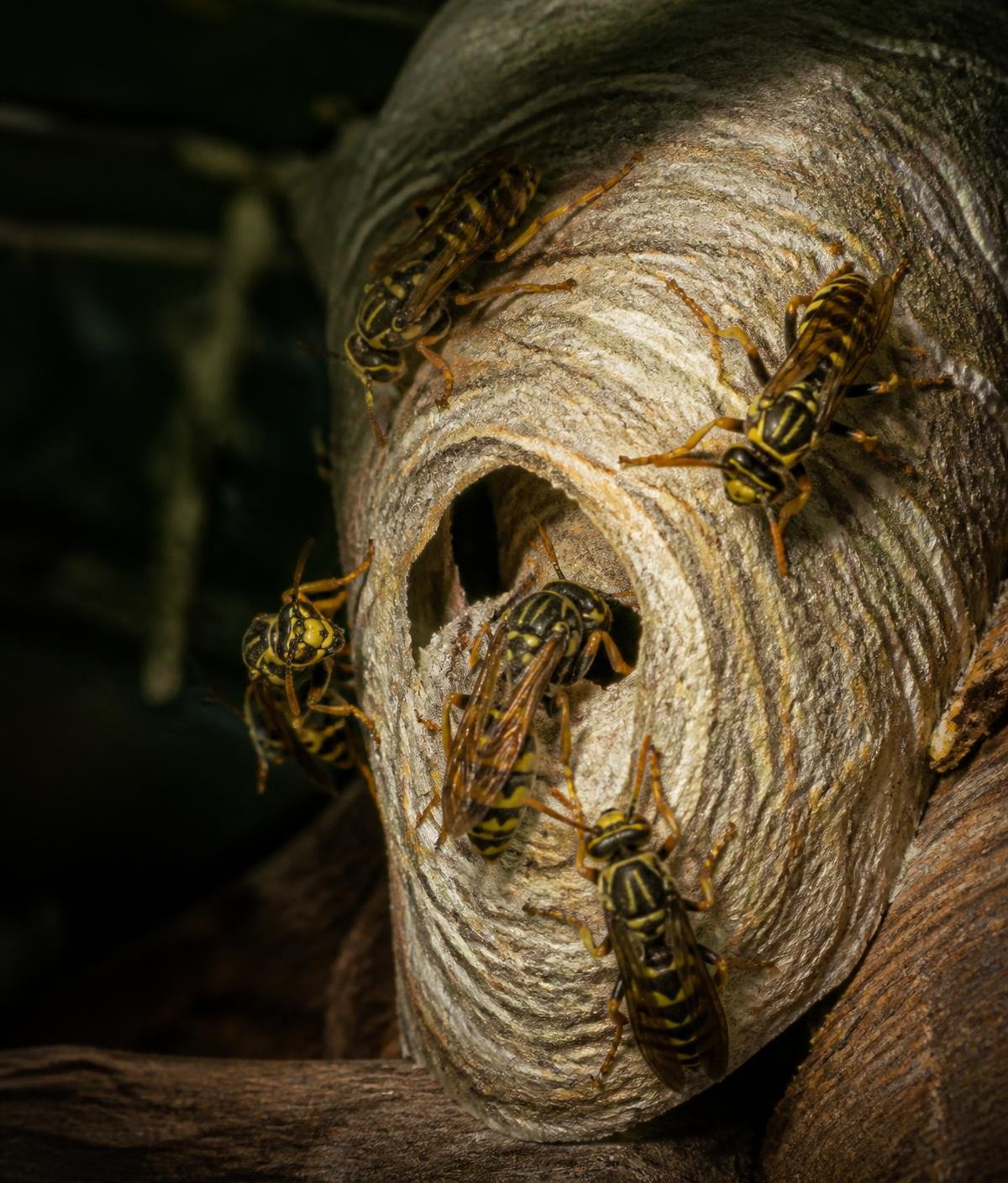
Before anything else, look at the body. Bees are generally furrier, rounder and more muted in colour — think dusty gold, brown or black. Wasps are smooth, shiny and sharply defined, with a distinct waist and bright lemon-yellow-and-black banding. If it looks like it's wearing a hazard-tape jacket, it's a wasp.
| Species | Look | Nest | Temperament |
|---|---|---|---|
| Honeybee | Golden-brown, slim, fuzzy | Hive, tree cavity, occasionally a wall void | Calm unless the hive is disturbed |
| Bumblebee | Big, round, very furry, often orange-tailed | Old mouse holes, compost heaps, under sheds | Placid, rarely stings |
| Tree bumblebee | Ginger thorax, black body, white tail | Bird boxes, roof voids, air bricks | Can 'ball' at the entrance in June but not aggressive |
| Mining/masonry bee | Small, slim, gentle flight | Individual burrows in lawns or soft mortar | Solitary, essentially harmless |
| Common wasp | Bright yellow and black, smooth, shiny | Loft, shed, hedge, underground — papery grey nest | Defensive near the nest, can sting repeatedly |
Tree bumblebees and bird boxes
One of the most common Oxfordshire call-outs each May is a bird box that has suddenly filled with loud, low buzzing. This is almost always the tree bumblebee (Bombus hypnorum), a species that arrived in the UK in 2001 and has spread fast because it happily nests in bird boxes, roof gaps and old bird nests rather than underground like most bumblebees.
They can look intimidating — workers 'ball' around the entrance hole in a defensive cluster — but tree bumblebees are not aggressive toward people who leave them alone. The whole colony runs its course in a few weeks and dies out naturally, usually by the end of July. We'd always recommend leaving the box exactly where it is until then.
Mining bees and masonry bees in Cotswold stone
On older Oxfordshire properties — Cotswold stone cottages, softer lime-mortar walls in Jericho and east Oxford — you'll often see small, perfectly round holes appear in spring, each with a solitary bee going in and out. These are mining or masonry bees. Unlike wasps or honeybees, each female builds and provisions her own burrow; there's no colony to defend, so there's essentially nothing to treat.
Why we don't treat bees
Bee numbers have fallen sharply across the UK and they're essential pollinators for gardens, allotments and farmland right across the county. As a matter of policy we don't treat honeybee or bumblebee nests. If you have a genuine honeybee swarm — a dense, moving cluster of bees, often hanging from a branch — we can put you in touch with a local swarm collector, who will usually rehome it free of charge.
Where we do come in is once you've confirmed it's actually a wasp. If flight is fast and direct, the nest entrance is a single dark hole with constant traffic, and the insects are bright and shiny rather than furry, read our guide to spotting the signs of a wasp nest and get in touch.
Not sure? Send us a photo
A clear photo or ten-second video, taken from a safe distance, is usually all we need to identify the species over the phone or on WhatsApp — no call-out required just to find out what you're dealing with.
- Furry, gold or orange body and slow, meandering flight — almost certainly a bee.
- Smooth, glossy, bright yellow-and-black banding with fast direct flight — a wasp.
- Nest in a bird box with loud buzzing in May/June — tree bumblebee, leave it alone.
- Small individual holes in a lawn or soft mortar with gentle traffic — solitary bees.
- Single busy entrance hole with visible grey papery material — wasp nest, worth a call.
Once you've confirmed it's wasps, our treatment page explains what happens on the day, and our species guide covers the common and German wasps found across Oxford, Abingdon, Bicester and beyond.
Frequently asked questions
- Do you remove bee nests or swarms?
- No. Honeybees and bumblebees are protected in practice and important for pollination, so we don't treat them. We can point you to a local swarm collector who will usually come free or for a small donation.
- Why are tree bumblebees in my bird box a problem?
- They aren't really a problem — they're noisy for a few weeks in May and June, then the colony dies out naturally by August. The nest is not reused the following year.
- I found a hole in my lawn with bees going in and out. Is that a wasp nest?
- It could be either. Mining bees are solitary, fly gently and ignore you; a wasp nest at the same spot has constant fast traffic and audible buzzing from below ground. Send us a photo or short video if you're unsure.
- Are solitary bees dangerous?
- Almost never. Most solitary bee species barely sting at all, and males of many species have no sting. They nest alone in individual burrows rather than as a colony defending a queen.
- What does a masonry bee nest look like?
- Small, neat holes in soft mortar joints or crumbling render, often on a sunny south-facing wall, with gentle bees hovering nearby rather than an aggressive swarm.
- How can I tell a wasp nest from a bee nest without getting close?
- Watch flight paths from a safe distance for two minutes. Wasps fly in fast, direct lines to a single obvious entrance; bees potter, hover and often use several small entry points.
Related guides
We treat nests like this across Oxfordshire
Same-day wasp nest treatment from £99, including these areas:
Nest active? Don't leave it.
Confirmed it's a wasp nest, not bees? We offer same-day treatment across Oxfordshire from £99.
Call 01865 477311