
Guide · Where the nest is
Wasp nest in a shed or garage
The outbuilding nest most Oxfordshire households only discover the second or third time the door swings open — after the colony has had weeks, undisturbed, to grow.
Send a photo of the nest — fixed-price quote back in minutes, usually a same-day slot.
- 5.0 on Google
- Same-day service
- Fixed price from £99
- Free revisit guarantee
2,000+
Nests treated
Sheds, garages, summerhouses and allotment stores are some of the easiest buildings on a property for a wasp queen to colonise, because they are exactly the kind of structure people leave alone for long stretches. A garage used once a week, a shed opened only for the mower, a log store visited when the fire gets lit — each one gives a founding queen in April or May the one thing she needs most: total peace while she builds the first dozen cells.
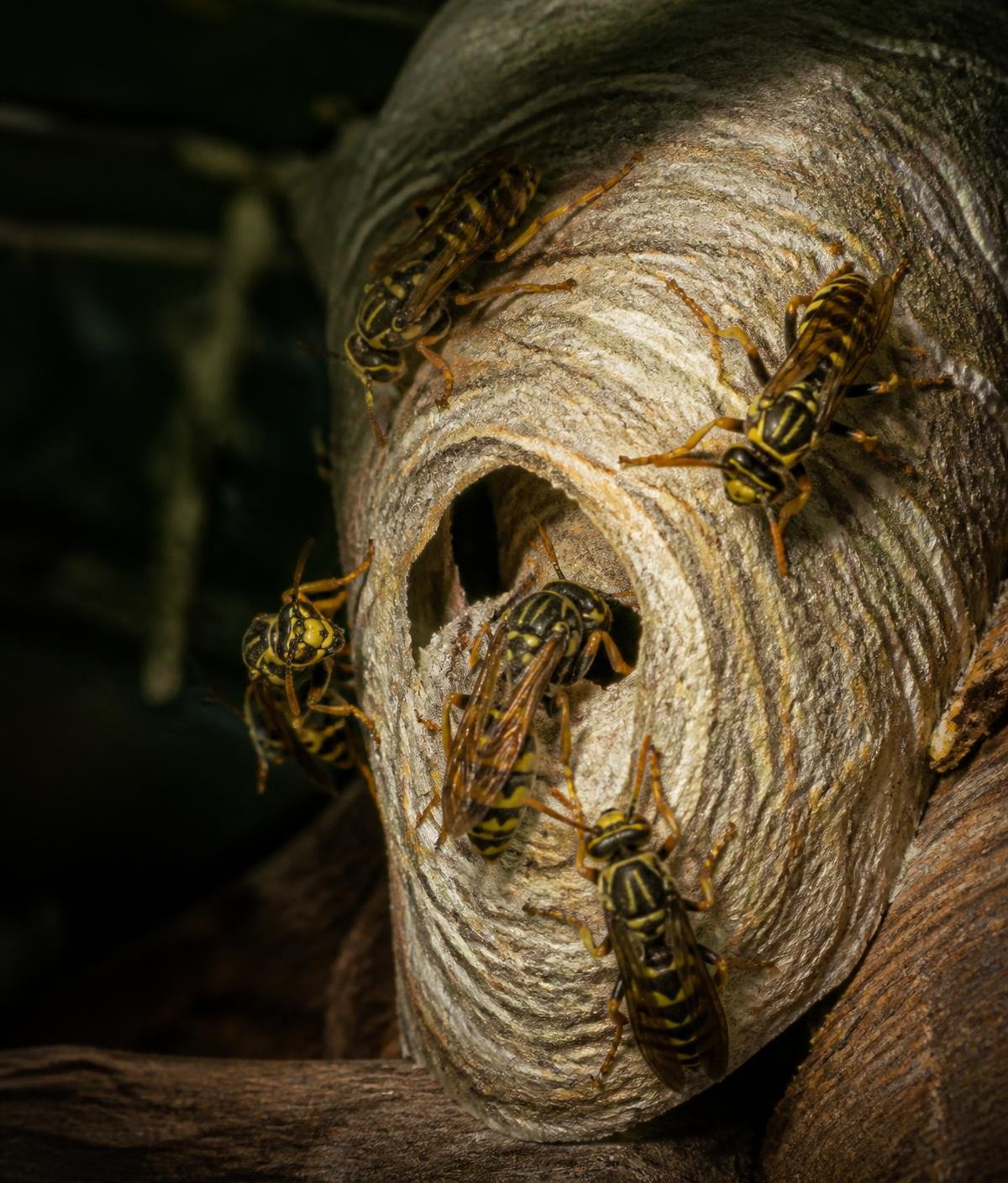
By the time most people notice, the nest is not a golf-ball on a rafter any more. It is established against roof felt, tucked behind stacked timber, or built into the angle where a stud wall meets the ceiling, and it has a workforce actively defending it every time the door opens.
Why the second visit is more dangerous than the first
The first time you open a shed door onto an active nest, the wasps are often simply disturbed by the light and movement — a few investigate, most stay put. It is the second, third and fourth visits that tend to go wrong. The colony has now logged the door as a recurring disturbance, guard wasps are already stationed near the entrance, and a nest that was tolerable in June is defending a population many times larger by August. We get a steady run of calls from people who managed the first two visits fine and were stung repeatedly on the third.
This pattern is especially common on allotments across Oxfordshire, where sheds are visited on a routine — watering in the morning, a dig at the weekend — that a nest can exploit for weeks before anyone gets stung.
Where they build inside an outbuilding
The most common spots we treat are the apex of the roof where two rafters meet, behind stacked items that are rarely moved (paint tins, deckchairs, seed trays), inside the cavity of a felt-roofed timber shed between the frame and the cladding, and around log stores where the gaps between split logs make a ready-made lattice of entry points. Summerhouses and garden offices with plasterboard-lined interiors can also hide a nest within the wall cavity itself, only visible as a patch of dark staining or a faint hum from inside the wall.
Don't reach past a nest for stored items
If you can see or hear the nest and it sits between you and something you need — tools, a mower, camping gear — leave it and call us rather than reaching past it. Guard wasps react fastest to movement close to the entrance, and outbuildings rarely have a second escape route if things go wrong.What we do differently in a shed or garage
Treatment itself is straightforward: an insecticidal dust or liquid applied directly at the nest entrance, timed for dusk or early morning when the colony is at its calmest and most of the workforce is inside. What differs in an outbuilding is the conversation beforehand — we ask what is stored nearby, whether the door needs to stay usable that evening, and whether pets or children use the space, so we can plan access without anyone needing to go near the nest itself.
For allotment sites and shared outbuildings, we also flag it if the nest entrance sits on a boundary or shared wall, since neighbouring plot holders are often unaware there is an active nest a few feet from their own shed.
- Fixed price from £99, agreed before we attend — no surprises for an awkward-access shed
- Same-day appointments across Oxford, Abingdon, Witney, Bicester and surrounding villages
- Treatment targets the nest entrance only — stored tools, paint and feed are left untouched
- Free revisit if any activity continues after treatment
If you are still deciding whether the nest actually needs treating at all, our guide to what happens if you leave a wasp nest covers how quickly an outbuilding colony grows through the season, and signs of a nest can help you confirm what you are dealing with before you call.
Frequently asked questions
- Why do wasps like sheds and garages so much?
- Sheds give wasps everything a hollow tree used to: dry timber to strip for nest paper, still air, a dark cavity, and a small gap — a warped door corner, a broken pane, a vent — to squeeze through. Once a queen picks a corner in April, nobody disturbs her again until the nest is the size of a football.
- Can I just stop using the shed until the wasps die off?
- You can, but it is often the worst option in practice. Allotment sheds and log stores tend to get opened at exactly the wrong moments — for a mower, for firewood, for tools — right through August and September when the colony is largest and most defensive. It also does nothing about a nest that has grown against the felt roof or timber frame.
- Is it safe to remove my lawnmower or tools from the shed myself first?
- Not if the nest is active and you have to walk past or near it to reach them. We would rather treat the nest first and let you retrieve items once the colony has died down over the following days, than have you disturb a defensive nest reaching for a strimmer.
- Will treating the shed damage anything stored inside?
- No. We apply an insecticidal treatment directly to the nest entrance and, where needed, a light application around it. It is not a fogging or fumigation of the whole building, so tools, paint, feed sacks and furniture stored nearby are not affected.
- What about wasps nesting in a summerhouse or garden office?
- Same principle, different stakes — a summerhouse is a living space, so we treat it as a priority same-day job wherever possible, particularly if children play in the garden or the building backs onto a patio used through summer.
- I found a nest in next door's shed that backs onto my garden — can you still help?
- We need permission to access and treat on the neighbouring property, but we're happy to speak to both parties to arrange it. Wasps from a shed nest forage widely, so it is worth sorting even if the entrance itself is not on your land.
Related guides
We treat nests like this across Oxfordshire
Same-day wasp nest treatment from £99, including these areas:
Nest active? Don't leave it.
Nest in the shed, garage or allotment store? We treat it from outside the danger zone — call for a same-day fixed-price appointment.
Call 01865 477311