
Species profile: Vespa crabro
The European hornet, explained
Britain's largest social wasp turns up more and more in Oxfordshire's wooded fringes — Wytham, Bernwood, the Chilterns edge near Henley — and increasingly in lofts too. Here's what it is, what it does, and whether it actually needs treating.
Send a photo of the nest — fixed-price quote back in minutes, usually a same-day slot.
- 5.0 on Google
- Same-day service
- Fixed price from £99
- Free revisit guarantee
2,000+
Nests treated
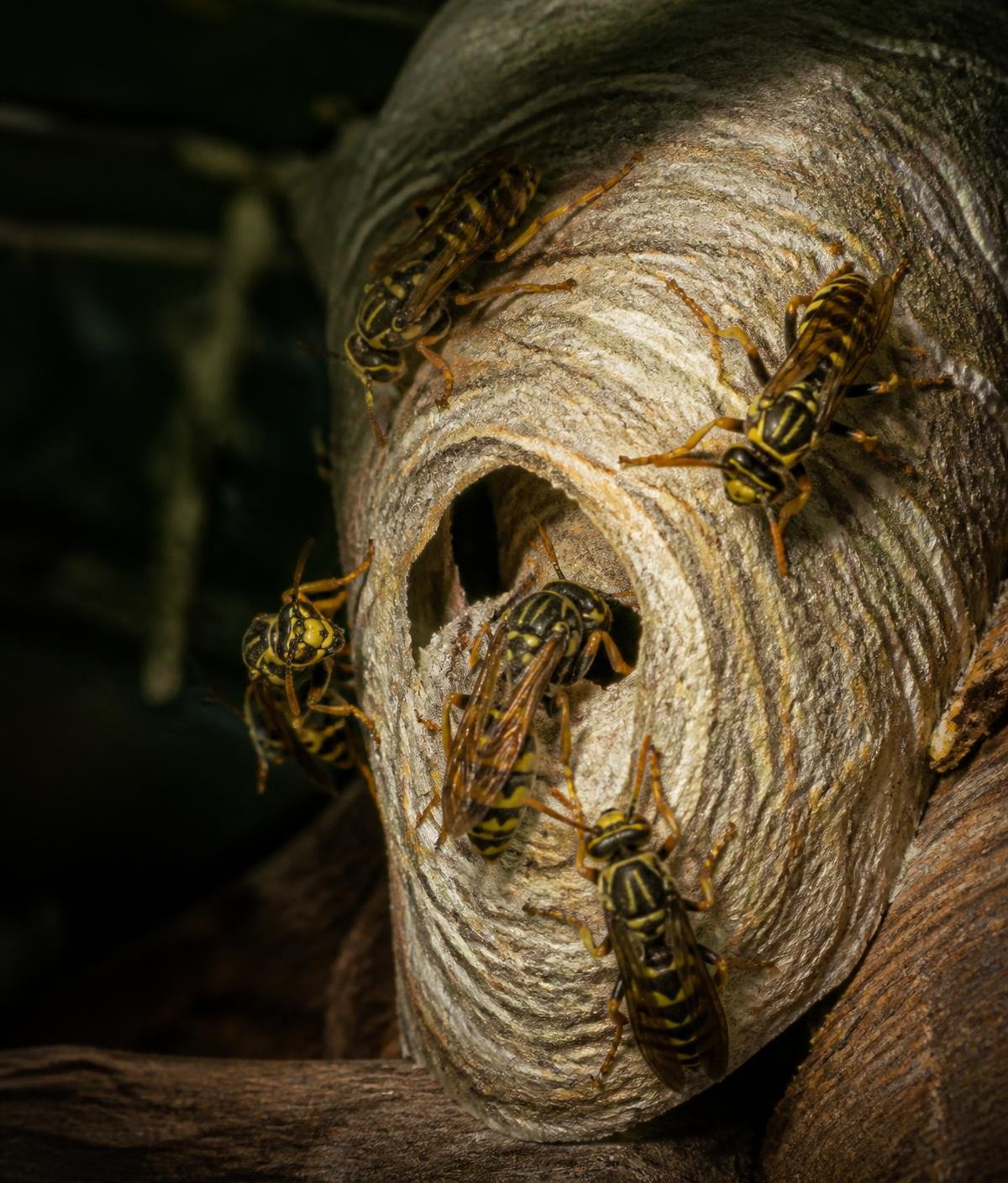
The European hornet, Vespa crabro, is a genuinely native UK insect, not a recent arrival, though sightings across southern England have crept up in recent decades. At 25-35mm it dwarfs a common wasp, with a chestnut-brown and yellow colouring that looks duller and more muted than a wasp's sharp black-and-yellow banding. The flight is unmistakable once you've heard it: a deep, resonant drone rather than a high buzz.
Size
25-35mm, roughly double a common wasp
Colouring
Reddish-brown thorax, yellow abdomen with brown bands
Activity
Unusual among UK wasps: forages after dark too
Nest sites
Hollow trees, loft voids, occasionally wall cavities
The nocturnal habit that alarms people most
Almost every call we get about European hornets mentions the same thing: they keep bumping into a lit window or porch light after dark. Unlike common and German wasps, European hornets carry on foraging into the evening and night, and are drawn strongly to artificial light — a security light, a conservatory left lit, a landing window. It looks deliberate and unsettling but is simple phototaxis, the same instinct that draws moths to a bulb. It isn't a sign of aggression.
Docile by reputation, not by guarantee
European hornets have a genuine reputation among pest professionals for being less defensive than wasps — individuals foraging away from the nest will generally ignore you entirely, and even close to a nest entrance they tend to give more warning before reacting. That said, "less defensive" is not "harmless": an established nest disturbed directly, by knocking a hollow branch or working near a loft void, will still respond, and a sting from a hornet's larger stinger is genuinely painful.
Where they nest around Oxfordshire homes
In the wild, European hornets favour hollow trees — old oaks and willows along the Thames and Cherwell corridors are typical. Around houses, we most often find them in loft voids of older properties near woodland, in wall cavities of Victorian villas in north Oxford, and occasionally in bat boxes or roof spaces of Cotswold stone barns and outbuildings on the Oxfordshire/Gloucestershire border. They rarely nest underground, unlike common wasps.
Do you actually need to treat it?
This is the honest answer we give on the phone: not always. If the nest is deep in a mature tree, well away from the house, a path or a patio, and nobody needs to go near it, the colony will die out naturally with the first proper frosts, just like a wasp nest — see our guide on when wasps and hornets die off. Treating it isn't necessary and, frankly, isn't always advisable given the height and access involved.
Where treatment does make sense: a nest in a loft directly above a bedroom, in a wall cavity near a doorway, in an outbuilding you need to use, or anywhere a household member has a known sting allergy. In those cases our treatment process for hornets follows the same principle as wasps — a targeted insecticide application at the entrance, left undisturbed to work through the colony.
Not every hornet call needs a technician
If you send us a photo of a nest high in a tree with no realistic access risk, we'll tell you honestly if it's one you can safely leave — we'd rather give free advice than charge for a job you don't need.
- Nest in a hollow tree, well away from paths and doors — usually safe to leave alone.
- Nest in a loft, wall cavity or outbuilding you use regularly — worth treating.
- Hornets bumping a lit window at night — normal behaviour, not aggression.
- Anyone in the household with a sting allergy — treat any nearby nest as a priority regardless of species.
- Suspect the abdomen is much darker and legs pale yellow — check it isn't an Asian hornet.
Still not sure what you're looking at? Our wasps vs hornets comparison covers the basics, and if the markings don't match a European hornet, go straight to our Asian hornet identification and reporting guide — that species needs a different response entirely.
Frequently asked questions
- Is the European hornet dangerous?
- Not especially. It's Britain's largest social wasp and looks alarming, but is generally calmer than the common wasp and rarely stings without direct provocation of the nest.
- Why do hornets keep flying into my kitchen window at night?
- European hornets forage after dark, unlike wasps, and are strongly drawn to artificial light. A hornet bumping against a lit window in July or August is simply following light, not targeting the house.
- Does every European hornet nest need treating?
- No. If it's in a mature tree well away from the house and nobody needs to go near it, many nests are best left alone to die out naturally with the first frosts. If it's in a loft, wall cavity or anywhere near foot traffic, treatment is worth arranging.
- How big does a European hornet nest get?
- A mature nest, usually inside a hollow tree, loft void or occasionally a wall cavity, can be considerably larger than a typical wasp nest by late summer.
- Are European hornets protected by law?
- No, they have no special legal protection in the UK, unlike some other insect species. They are simply a native species we're comfortable leaving be when there's no genuine risk.
- How do I know it's a European hornet and not an Asian hornet?
- European hornets have a reddish-brown thorax, yellow abdomen with brown banding, and orange-tinted legs. Asian hornets are darker overall with a near-black abdomen and distinctive pale yellow leg tips. See our Asian hornet guide for a full comparison.
Related guides
We treat nests like this across Oxfordshire
Same-day wasp nest treatment from £99, including these areas:
Nest active? Don't leave it.
European hornet nest in a loft, wall or outbuilding you need to use? We treat them safely, same-day, from £99.
Call 01865 477311