
Species deep-dive
Common wasp vs German wasp
Vespula vulgaris and Vespula germanica are responsible for the vast majority of nests we treat across Oxfordshire. They look near-identical at a glance — here's how to tell them apart, and why it barely changes what we do about them.
Send a photo of the nest — fixed-price quote back in minutes, usually a same-day slot.
- 5.0 on Google
- Same-day service
- Fixed price from £99
- Free revisit guarantee
2,000+
Nests treated
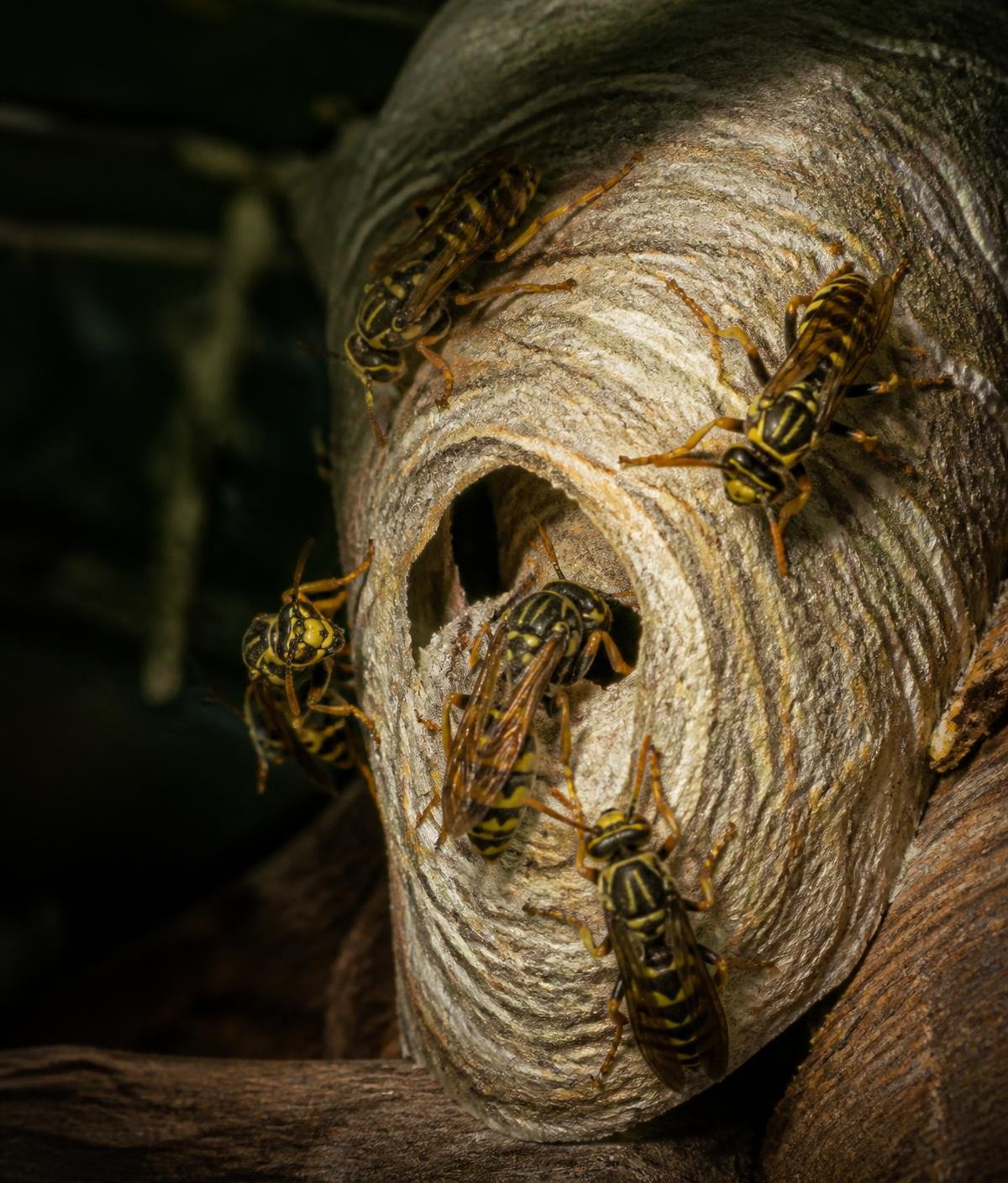
If you've had a wasp problem in Oxford, Kidlington or Bicester this year, it was almost certainly caused by one of two species: the common wasp (Vespula vulgaris) or the German wasp (Vespula germanica). Both are social wasps that build the familiar grey, papery, football-sized nest, both follow the same seasonal life cycle, and both sting for exactly the same reason — defending the colony.
Face markings: the reliable tell
The single most reliable difference is on the face. The common wasp has a black marking on its clypeus (the front of the face) shaped like a solid anchor or dagger. The German wasp instead has three separate black dots, sometimes fused into a shape resembling a distorted face, on the same area. This is the feature entomologists use, but it requires a clear close-up view — not something to go hunting for around a live nest.
| Feature | Common wasp (V. vulgaris) | German wasp (V. germanica) |
|---|---|---|
| Face marking | Solid black anchor/dagger shape | Three separate black dots |
| Body markings | Slightly less symmetrical black patterning | Sharper, more symmetrical black bands |
| Preferred nest sites | Lofts, sheds, hedges, underground | Wall cavities, lofts, occasionally underground |
| Nest envelope colour | Grey, papery, slightly coarse | Grey, papery, often a touch smoother |
| Typical colony size | Up to a few thousand workers | Can run slightly larger in a good summer |
| Sting risk to people | High near an active nest | High near an active nest, sometimes quicker to respond |
Nest sites: subtle tendencies, not hard rules
In our experience across Oxfordshire, common wasps are the ones most often found nesting in garden hedges, compost heaps, shed roof voids and old rodent burrows in lawns — see our guide to underground wasp nests for more on that particular hazard. German wasps show a stronger tendency toward enclosed cavities: wall voids in 1930s-70s Botley and Didcot semis, loft spaces, and gaps behind soffits. Both species will happily use any of these sites though, so location alone is never a firm identification.
Behaviour and temperament
Both species are placid while foraging away from the nest — a wasp investigating your picnic in June is not being aggressive, it's looking for protein or sugar. The behaviour that matters is proximity to the nest itself. Vibration from a lawnmower, a knock against a shed wall, or simply walking past an entrance hole too often can trigger a defensive response from either species. German wasps have something of a reputation among pest controllers for reacting slightly faster and in slightly greater numbers, but this is a generalisation, not a rule you should rely on.
Nest material
Both chew weathered wood into a paper pulp
Colony peak
Late July to September for both species
Founding queen
One overwintered queen starts each nest, either species
Treatment approach
Identical insecticide dust and process for both
Why it doesn't change your treatment
Whichever species has moved in, an active social wasp nest needs the same professional approach: locating the entrance, applying an insecticide the returning workers carry back into the colony, and leaving it undisturbed while it takes effect. See our treatment process for exactly what a visit involves.
If you're trying to work out whether what you've got is a wasp at all — as opposed to a bee or a hornet — start with our guides on bee or wasp identification and wasps vs hornets. And if you've already spotted an active nest of either species, don't wait for it to grow: our wasp life cycle guide explains why nests only get bigger and more defensive as the season progresses.
Frequently asked questions
- Does it matter which species is nesting in my house?
- Not for treatment — the method, insecticide and price are the same for both. It's mainly a point of interest, though German wasps do have a reputation for being a touch more short-tempered near the nest.
- How do I check the face markings safely?
- Never approach a live nest to inspect faces up close. If a wasp lands on a window or is caught in a photo, look for the anchor/dagger mark (common) versus three separate black dots (German). Otherwise leave identification to us.
- Which species is more common in Oxfordshire?
- Both are widespread and populations vary year to year. In most seasons the common wasp is slightly more frequently reported, but German wasps are common enough that we treat plenty of German wasp nests every summer.
- Do German wasps make bigger nests?
- Colony sizes overlap heavily, but German wasp colonies can grow slightly larger on average and are a little more inclined to nest in wall cavities and lofts rather than open garden sites.
- Can the two species interbreed or hybridise?
- No, they're distinct species that don't interbreed, though they're frequently confused because their yellow-and-black colouring is so similar at a glance.
- Is one species more likely to sting?
- Both defend an active nest vigorously. Anecdotally German wasps are considered slightly quicker to respond to disturbance, but the practical advice is identical: keep well away from any active nest of either species.
Related guides
We treat nests like this across Oxfordshire
Same-day wasp nest treatment from £99, including these areas:
Nest active? Don't leave it.
Common or German wasp, the treatment is the same — fixed price, same-day appointments across Oxfordshire.
Call 01865 477311